
Know your muscles, without the Jargon! The Lower Body.
THE LEGS, HIPS AND BUTTOCKS.
There you are doing your best to follow an online conditioning programme and the instructor says “On the downward phase of these squats, the quadriceps are under an eccentric loading pattern. To maximise your muscle workload you should be squeezing your glutes as you drive upwards.”
Squeeze my what???? Thats Greek to me (well it’s derived from Latin actually but that’s neither here nor there.) You can’t ask the television for an explanation and by the time you have googled the answer, any motivation you had to squeeze whatever it was has long gone!
On the other hand some Personal Trainers will try to impress you with their knowledge, by coming out with some uncomprehensible terminology which you are so bamboozled or intimidated by, that you are afraid to ask exactly what they meant!
Never fear. Weald Fit and Therapy can debunk the jargon in these blogs starting here with the lower body so next time you know where you should be squeezing starting with:
THE GLUTES / GLUTEAL MUSCLES.
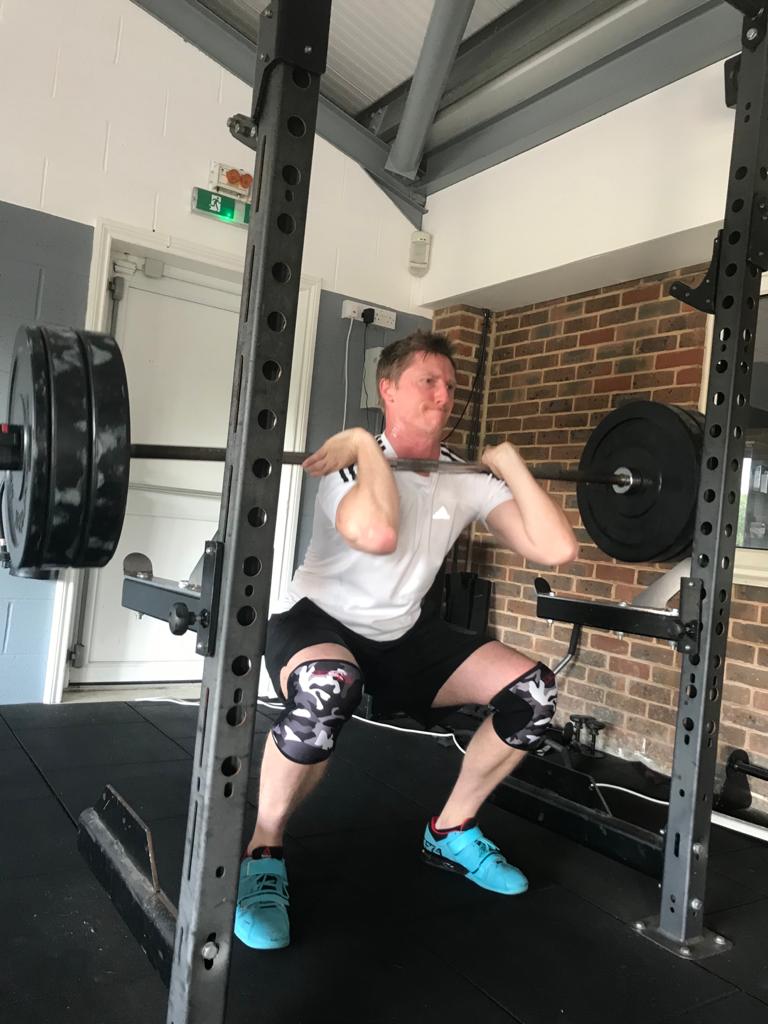
You are sitting on them! There are in fact the 3 main muscles that make up your backside and are named according to their size (Gluteus Maximus, Gluteus Medius & Gluteus Minimus) although they do tend to sound like characters from the old TV series “Up Pompeii”. They all are attached to the rim of the pelvis, forming the meaty curve of the buttocks and can usually be noticed the most if you are walking or running up a steep hill, or as in the introduction, pushing up from a squat position especially if you are adding extra weight to the activity as shown in the photo of Daniel training.
THE HIP FLEXORS.
These muscles are difficult for the lay person to find as they run diagonally from back of the body to the front, that is from the inner edge of the spinal column to the top of the leg near the groin. Tight hip flexors can have a detrimental effect on posture and be the cause of considerable pain and back discomfort. Because of their origin at the spine, they can pull on the lumbar vertebrae causing the pelvis to tilt so causing an excessive arch.
THE HAMSTRINGS.
Often injured in sports and other activities, these muscles form the back of the thigh. This group runs from your sit bones to below the knee and are comprised of 3 muscles that all work together to bend the knee, with the more dominant of the 3 also helping the gluteus maximus (see first description paragraph). As we generally spend most of our day in a seated position, i.e. with the knees bent, these muscles can easily become tight and inflexible hence they are more easily damaged than their opposing muscle group being…
THE QUADS/ QUADRICEPS.
Quads =4 Ceps=heads. In other words, 4 muscles that make up this group with one more noticeable than the others as the knee cap is situated within its tendon. Hence an imbalance within the group of the 4 muscles will lead to problems with the knee, especially the one nearest the inside of the thigh which is frequently under active especially in comparison to ….
THE ILIOTIBIAL BAND / ITB.
This is in fact not a muscle, but a fibrous band that is attached to a muscle that runs from the hip to about 1/3 of the way down the outside of the thigh where it forms the ITB, which in turn continues to the lower part of the outside of the knee. Tightness here, amongst other faults, can cause rubbing and the pain known as Iliotibial Band Syndrome aka. ”Runners Knee”. However this is not just seen in long distance runners but also in cyclists, weight lifters and with military training to name but a few activities.
THE ADDUCTORS.
This is a much neglected muscle group in many less structured training programmes. Running down the inner thigh from the groin to the knee, this is activated by drawing the leg towards the midline of the body and imbalances can be easily be remedied by adjusting the feet when performing, for example a squat with a wider foot placement.
THE CALF MUSCLES and THE ACHILLES TENDON.
Firstly, the big bulky powerful one that makes up the curvature of the lower leg is the Gastrocnemius. It helps the hamstrings to bend the knee, so it begins just above the back of the knee and merges at the base of the bulk with the Achilles Tendon. It is usually this muscle that is at fault if you are unfortunate enough to wake up with cramp in your calf in the middle of the night. You will certainly feel the effects of this “involuntary contraction” the next morning!
Secondly, the predominantly postural calf muscle is called Soleus and does not assist the hamstrings in bending the knee. With the Gastrocnemius it does allow you to lift up on tip toes and it tracks from below the back of the knee, underneath Gastrocnemius and the Achilles to insert in the heel bone. It can be felt either side of the tendon but without its constant tension the body would fall forwards.
Thirdly there are various deep calf muscles. Wiggle your toes in your shoes and you will feel the arch of your foot working. It’s these deep calf muscles that are moving your toes and it is often tightness in these deep muscles that cause cramp under the base of your foot.
Finally, the Achilles Tendon is under tremendous load. Should you be unfortunate enough to completely rupture this tendon, it sounds as though somebody has been shot; it is that loud! Some patients reporting that it feels as tough they have been struck forcefully on the back of the leg. Immediately the Gastrocnemius may well recoil all the way up to behind the knee for a complete rupture, hospital intervention is necessary and as quickly as possible. Depending on age, activities usually undertaken, severity of the injury and other medical factors, surgery may be required in order to reattach the tendon. With either the surgical or non-surgical route it is a very long road to recovery, using a cast or surgical boot with complete immobility for weeks. Extensive rehabilitation will be required and problems can be experienced for up to a year. However, that is for a complete rupture. Sometimes smaller tears are ignored as the patient is able to walk, can stand on the toes with both feet (but not the injured one in isolation). So, they continue doing what they were doing before rather than seek treatment and then ….. wham – considerably worse Achilles injury! An Achilles injury should never be ignored however minor it may appear. And finally…..
THE TIBIALIS ANTERIOR.
Attached to the Tibia (the larger of the two shin bones) and at the front of the leg (Anterior) this muscle runs close to the skin and pulls the foot upwards as in tapping your toes in time with music. If you are unfortunate to be diagnosed with “Shin Splints” it is where this muscle has partially detached itself from the shin and as a result is extremely painful to the touch, often with a slight bulge. There is usually an associated problem with the deeper shin muscles and is commonly caused by overuse, often with impact such as seen in gymnasts, dancers and runners. Ignoring the warning signs can lead to further problems that are not so ease to rehabilitate from, such as a Stress Fracture.
Of course there are plenty of other lower body muscles which are not addressed in this Blog, such as the Piriformis which is located deep in the buttocks and can cause Sciatica type problems, so if you are in pain don’t suffer in silence please contact Weald Fit and Therapy and we will offer best advice to help during lockdown and of course an appointment is always best policy when the treatment room is operational again.
In the meantime, you now know where and what to squeeze when performing a squat, without having to asking Google!
