
Speed Training for Association Footballers

Do You Want to Improve Your Speed?
In a world where humans are striving to be the best they can be, and with a much greater understanding of how the body works, many of us are using the gym to improve our sporting performance. That includes Association Football players, at all levels of the sport.
As a Personal Trainer, I am getting more and more clients coming to me who want to be better at their sport. The important attributes for a Football player are speed, strength, agility, cardiovascular endurance and skill level. Whereas skill acquisition can be limited by your natural ability, the other attributes can be vastly increased through training. The importance of these attributes depends on your playing position. For example, a Goal Keeper requires a higher level of agility and less cardiovascular fitness, yet a winger needs a high level of cardiovascular fitness and speed.
In this article, I’m going to focus on how you can improve your speed through training. Speed comes from the engagement of what’s called the fast twitch fibres which are found in the skeletal muscles.
Jacob Wilson Ph.D from www.bodybuilding.com states, “Fatigue is your friend. Along with intensity, fatigue is a surefire way to increase fast twitch muscle fibre recruitment. Your body’s first impulse is to recruit slow-twitch fibres, but once you fatigue those fibres, it has to recruit fast twitch fibres to do what is being asked of it”
Therefore you want to design your gym training programme to improve speed in the following format; warm up, dynamic stretching, resistance exercise, explosive exercise, cool down and finish with a static stretches. Below is a sample session plan.
Warm Up
Heart rate raiser, getting you physically and mentally ready for the session, for example 5 minutes on the rowing machine.
Dynamic Stretching and Trigger Point Therapy
The muscle groups which will need to be activated and mobilised to prevent injury in the session. Butt flicks (a) will engage the Quadriceps and Hamstrings. Alternatively bring one leg to your bottom and then the other for 30 seconds. A Child Squat (b) will mobilise the hips. Squat as deep as you can, keeping your feet flat, knees out and your chest up. Once at the lowest point, bring the toes up on one foot and then continually swap for 30 seconds. If you have an issue with balancing, you can hold on to for support. A Camel/Cattle stretch will mobilise abdominal and back muscles. Every three seconds, change between the two positions shown in (c), and continue for 60 seconds in total. Use of the foam roller, called Trigger Point Therapy, should now be utilised on sore muscles, caused from previous training. How to foam roll the Quadriceps is shown in diagram (d). Lay in a plank position on the floor, with the roller under the Quadricep and “GI Joe” the other leg to the side. Slowly roll it up and down the muscle three times, stop on the spot that “talks” to you the most and then use a side to side sawing action, rubbing across the roller on that point for 5 seconds. Change legs when completed.
Butt Flicks (a)
Child Squat (b)
Cattle Camel (c)
Foam Roll Quadriceps (d)
Resistance Training
We are going to use the Olympic Front Squat (e) to fatigue the muscles. If you are new to training, the body weight squat should be utilised, bringing more resistance in as your strength improves. 6 sets x 12 reps with 90 seconds rest between sets. Keep the elbows up as you squat to keep the Olympic bar resting on the shoulders, core engaged, hips forward and glutes engaged by keeping the knees out at the lowest point of the squat.
Olympic Front Squat (e)
Explosive Exercise
Box Jumps (f), when performed correctly, are a fantastic exercise for improving leg power. (Speed x Strength = Power). 6 sets x 10 reps with 60 seconds rest. Increase the height of the plyo box as your leg power increases with training. Ensure you land as lightly as possible and with the keeps out.
Box Jumps (f)
We will finish the explosive exercises with Sledge Runs. Either running with a sledge behind you connected by a harness, or as shown in (g), pushing the sledge. Try and run at maximum speed and in short bursts with 30 seconds rest between sets for six sets.
Tank/Sledge (g)
Cool Down and Static Stretches
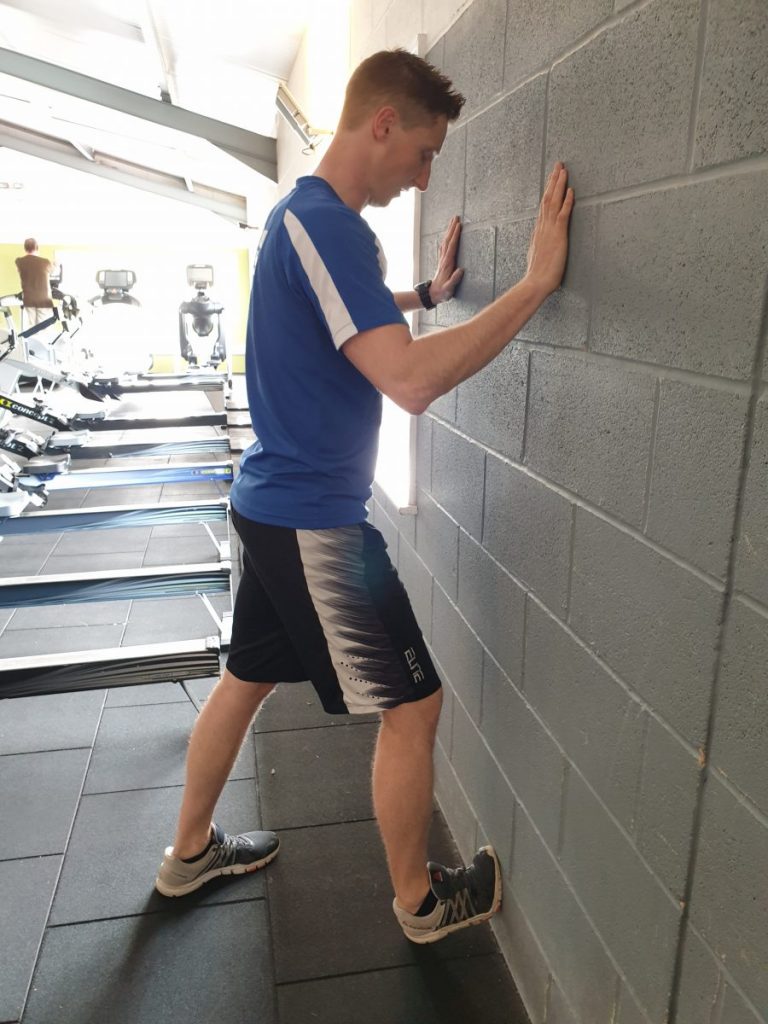
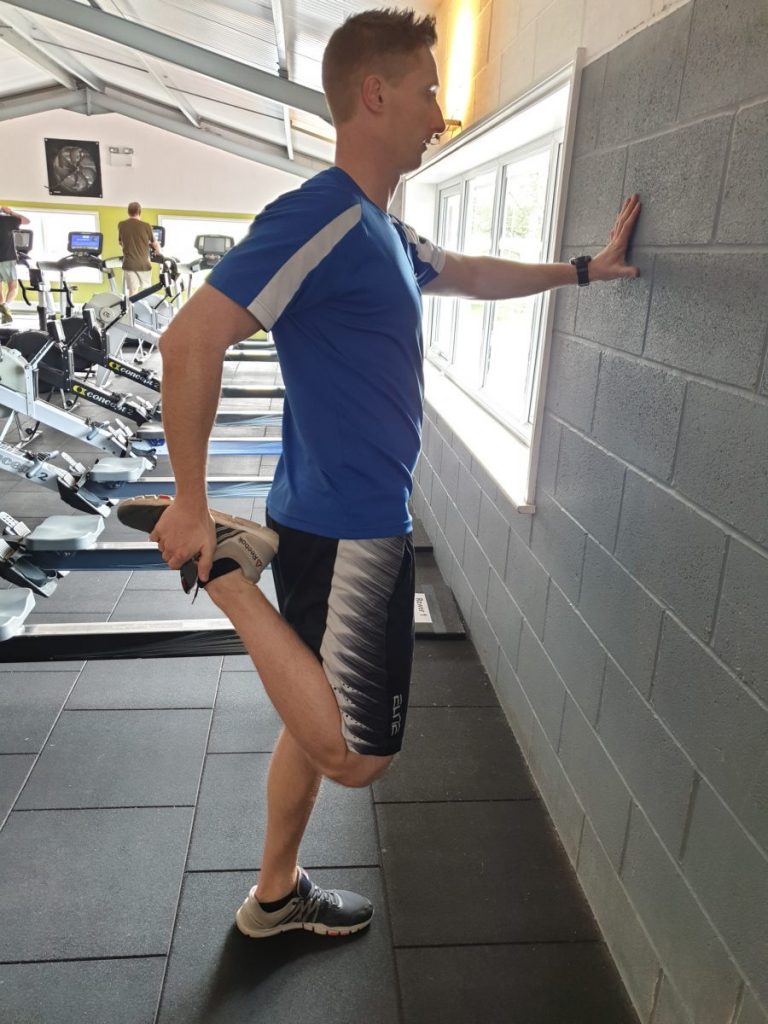
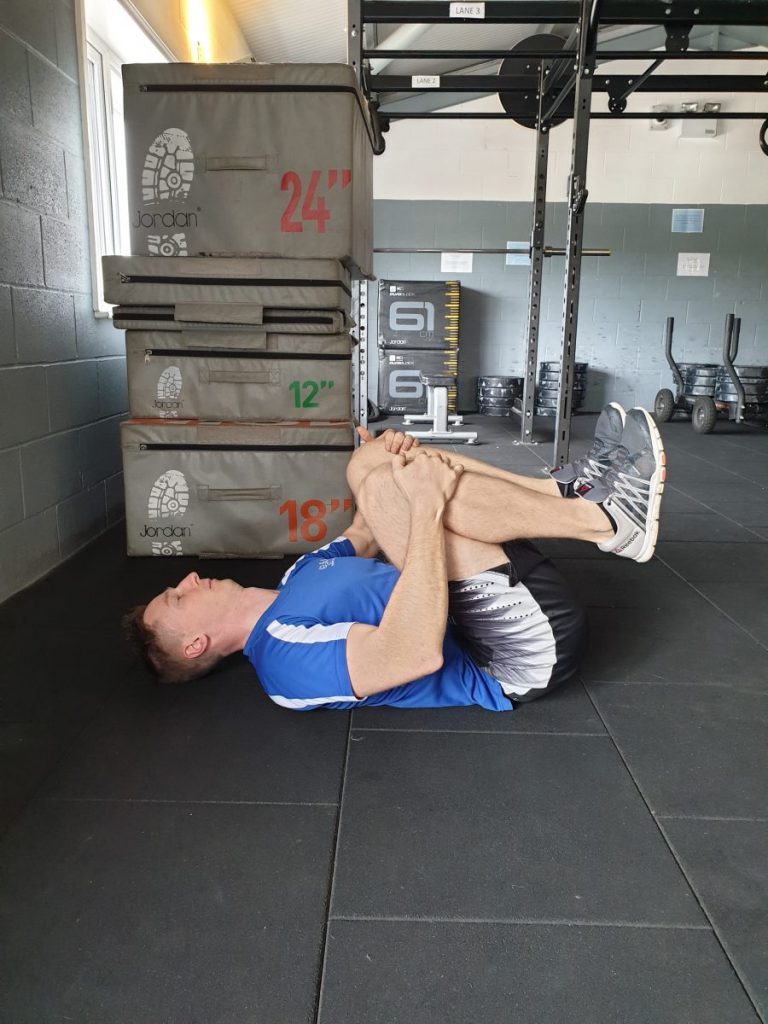
Finish the session with five minutes gentle cardiovascular work, allowing the heart rate to reduce down and the lactate to be flushed out the skeletal muscles. For example, a cycle on an upright bike. Then static stretch the muscles used in the training session. We need to stretch the Calves (h), Quadriceps (i), Hamstrings (j), Glutes (k) and Lower Back (l). Hold all the stretches for 30 seconds.
Calves (h)
Quadricep (i)
Hamstrings (j)

Glutes (k)

Lower Back (l)
If you require any further help with your training, or this article has raised any questions, please contact us or email mail@wealdfitandtherapy.co.uk
Daniel James (BA Hons)
Personal Trainer
Weald Fit and Therapy
