
Know your muscles, without the Jargon 4! The Core
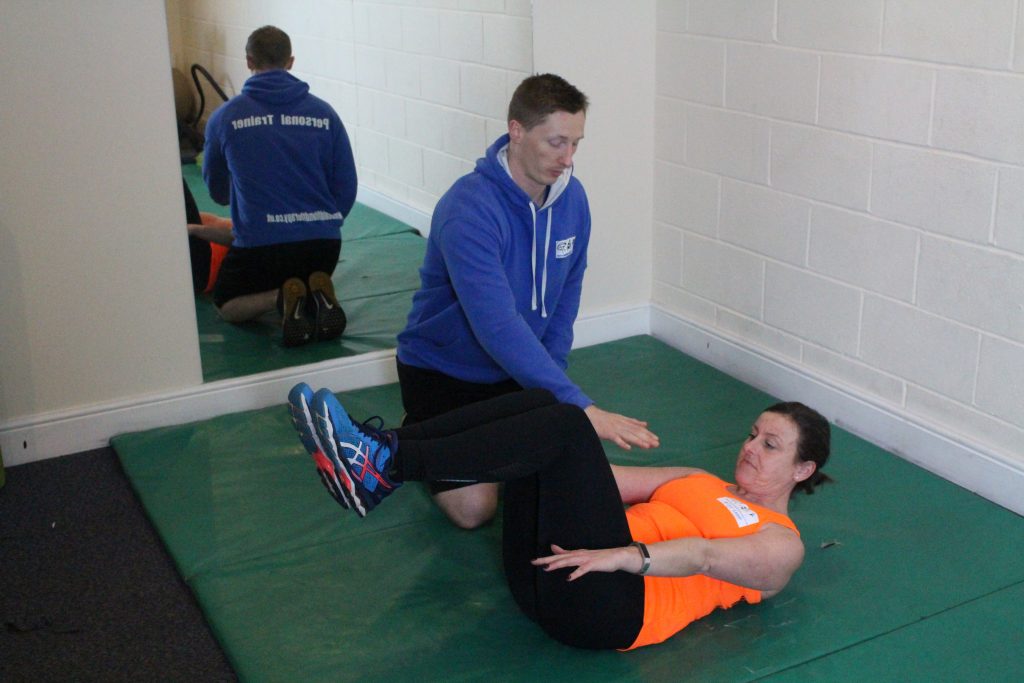
UNDERSTANDING THE CORE.
Whether it is online, via You Tube, on a DVD or in the gym and studio, all instructors go on and on about “engaging the core muscles”. Has anybody ever explained exactly what the core muscles do and why they are so important? Weald Fit and Therapy are going to do exactly that in this blog and how to find them so that you can “engage” or “brace” them correctly!
Many people wrongly assume that the core is referring to the abdominal muscles. Well yes, they are involved but that is far from the whole picture.
Imagine the centre of your torso as being a box with the abdominals forming the front and the two sides of the cube, more about those muscles later in the blog.
The back of the box is made up from the back extensor muscles, often grouped together to be called the ERECTOR SPINAE group, with one deep muscle in particular being a major core muscle:
THE MULTIFIDUS.
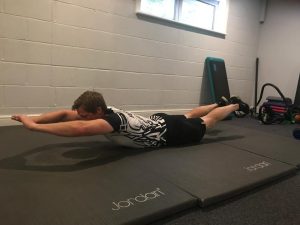
This muscle in one of the smallest yet the most powerful muscles that takes the pressure off the intervertebral discs so that pressure and body weight is evenly distributed along the length of the spinal column. It fills up the grooves on each side of the vertebral spines from the pelvis to the top of the neck. The superficial muscle segments keeps the spine straight while the deeper layers stabilise the vertebral column.
Studies have found that the Multifidus muscles are activated before any action commences to protect the back from injury, preparing the body for movement. For example if you are about to reach out and pick up the kettle, the Multifidus muscle begins contracting prior to the arm starting to move.
One particular study (published 2002 by The European Spine Journal) featured those suffering with lower back pain, especially patients suffering chronic (long term) problems in comparison with those with healthy backs. Electromyographic activities of the Erector group in general showed that low back pain subjects displayed much reduced Multifidus activity compared to those with healthy backs when attempting co-ordination exercises, such as walking. This indicated that over a period of time, patients had a reduced ability to voluntarily recruit the Multifidus muscles to maintain neutral spine alignment.
Does this scenario sound familiar? Daniel from Weald Fit and Therapy has undertaken specific back rehabilitation training to help you re-educate your Multifidus to work correctly so as to ease your back discomfort. Please contact him via our website or on 07882 511602 for details as to how he can help.
So returning to our box of core muscles. The lid of the cube is your DIAPHRAGM which is involved in all explosive actions such as sneezing and of course, when breathing. It is a domed-shaped muscular partition separating the thorax from the abdomen. The base of the box is formed of the PELVIC FLOOR MUSCLES which extend like a muscular trampoline from the coccyx (tail bone) to the pubic bone and is potentially weaker in females due to their construction in comparison to a mans. However both sexes can unfortunately have problems in this region and yes, Daniel can help here too having specific training in this area. If you are in wondering how the DIAPHRAGM and the PELVIC FLOOR are connected, place your hand on your stomach and gently cough. You will feel your tummy bouncing at the same time as your pelvic floor contracting upward and the diaphragm dropping down.
The abdominal muscle that you felt bouncing when you coughed is the body’s internal corset and is called…
THE TRANSVERSE ABDOMINIS (TVA).
This is the deepest of the muscles that form the front and sides of your core box. It is divided into two sheaths each centrally attached from the base of the sternum (breast bone) to the pubic bone via the linea alba (that is the visible line seen in bodybuilders down the midline of the stomach). It sweeps around the sides of the torso attaching to the ribs and hip bones (the iliac crests), finishing at the thoracolumbar fascia as detailed in blog 2, the upper body.
This muscle is vitally important as one of its functions is to protect and maintain the tone of the internal organs that lie beneath, although the sheaths work independently when side bending or rotating the torso when the muscle provides thoracic and pelvic stability.
Its other role, with both sheaths are contracting together is when working in tandem with the Multifidus, as previously described. Without a stable spine, aided by proper contraction of the TVA, the nervous system fails to recruit muscles in the correct order.
So how is a contraction of the TVA achieved? Here is one description of how to “engage the core muscles” correctly which is sometimes referred to as “the Vacuum” or “bracing” the abdominals:
*Place the heel of your hand on each hip bone, with fingertips towards the middle of the stomach. Now imagine a piece of string attached from your pubic bone to your tummy button continuing to pass through your body, emerging through your back. Somebody has shortened that piece of string, pulling it upwards and drawing it towards your spine.
You should experience tension from hip to hip while the tummy button feels as though it is being pulled up under the rib cage. That’s it!
*Now for a specific TVA strengthening exercise:
If you have access to a blood pressure cuff (which is unlikely for most) you can actually measure your progress by reading the pressure on the dial. Lying on your back, place a partially inflated cuff under your lumbar arch. Engage your core muscles as described above and hold for a count of 10; the needle should swing round to indicate an increased pressure. Relax the muscles and watch the needle drop back.
Repeat the core contraction but this time, slowly breathe whilst maintaining the elevated reading on the dial, holding that contraction for a little longer. Much more difficult!! And relax the muscles so the needle drops again.
So, what if you don’t have a blood pressure cuff readily available? Well, try putting your hands palm down with fingertips touching under your lumbar back then squash them into the floor using core activation, hold for a count of 10 and release. Feel the pressure decrease on your hands. Once you can feel the TVA activation and release, try crushing both hands while breathing as described above. The more you consciously utilise your TVA the more readily it activates, which is a prerequisite with any abdominal training let alone using weights etc.
And here is the BIG BONUS ……. YOUR LOWER ABDOMEN WILL APPEAR FLATTER!
Now for the 2 layers of abdominal muscles that cross cross around the sides of the torso……
THE INTERNAL and EXTERNAL OBLIQUES.

These broad thin superficial muscles lie one on top of the other over the deeper TVA, forming the sides of the abdomen. When one side pair contracts, the torso bends &/or rotates in that direction. At the same time the opposing pair on the other side of the body has to relax in order for that movement to occur. So which direction do the muscles actually run? The word oblique means “slanted” or “diagonal” thus literally indicating the direction of the muscle fibres. Place your hands in your coat pocket – you generally wear your coat over your indoor clothing . 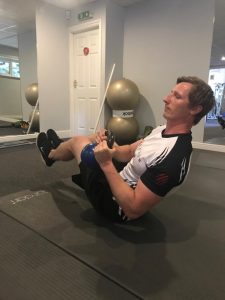 This is the line of the EXTERNAL OBLIQUES that run from the side of the 5th to 12th ribs down to the linea alba (centre of the abdomen) and the onto hip bones (iliac crests). The INTERNAL OBLIQUES is obviously the deeper of the two sets of muscles, originating on the iliac crests, the pubic bone and the thoracolumbar fascia then tracking upwards and around the torso to the linea alba and the front of the ribs.
By the way, next time it’s your birthday you can thank your INTERNAL OBLIQUES. They will help to blow out the candles on your cake by contracting to force air out from your lungs working with all the other muscles of respiration, which also includes the diaphragm as previously mentioned, being the lid of your core box.
Now here is another weird one – an abdominal muscle that is located purely in your back!
THE QUADRATUS LUMBORUM / QL.
This is in fact, your deepest abdominal muscle and is found in your lower back between the top of your pelvis and your lowest rib. The QL supports and stabilises your lumbar spine when you side bend or raise from a bent over position. It is another muscle that has a significant impact on good posture and long periods of sitting can contribute to a reduced blood flow to the area. Many clients have visited me in my treatment room in Pre- Covid times, needing assistance with QL muscle spasms, overuse injuries or general muscular strains due to back weaknesses and muscle imbalances.
Finally…. THE RECTUS ABDOMINIS.
Often referred to, incorrectly, as “the Six Pack”, so why is that a misnomer?
The Rectus Abdominis is a superficial paired muscle, set vertically either side of the Linea Alba. Each sheath originates on the pubic bone and inserts at the base of the breastbone (Sternum) and on the ribs at either side. The muscle is interrupted widthways by at least 3 fibrous bands, called tendinous intersections, that therefore subdivide each sheath into 4 or sometimes 5 segments. Should you see the entire muscle on a well trained athlete, with low levels of body fat plus essentially, the correct gene pool you will see an 8 or even a 10 pack!
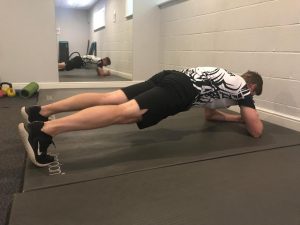
Crunches are the standard exercise to contract and thereby work this muscle. However without correct core engagement, the exercise would be ineffective and possibly a contributing factor to back pain. Whole body exercises such as “The Plank” utilise all the core muscles in balance and should be included your abdominal training. Secondly, just focusing on crunches and their variations such as torso twist bicycle abs and sit ups will not get you that definition everybody wants, however many you do although specific muscle density will be increased. The previous paragraph says it all; reducing body fat levels will make muscle definition more visible but essentially when it comes down to the nitty gritty, you can thank your parents – or not!
